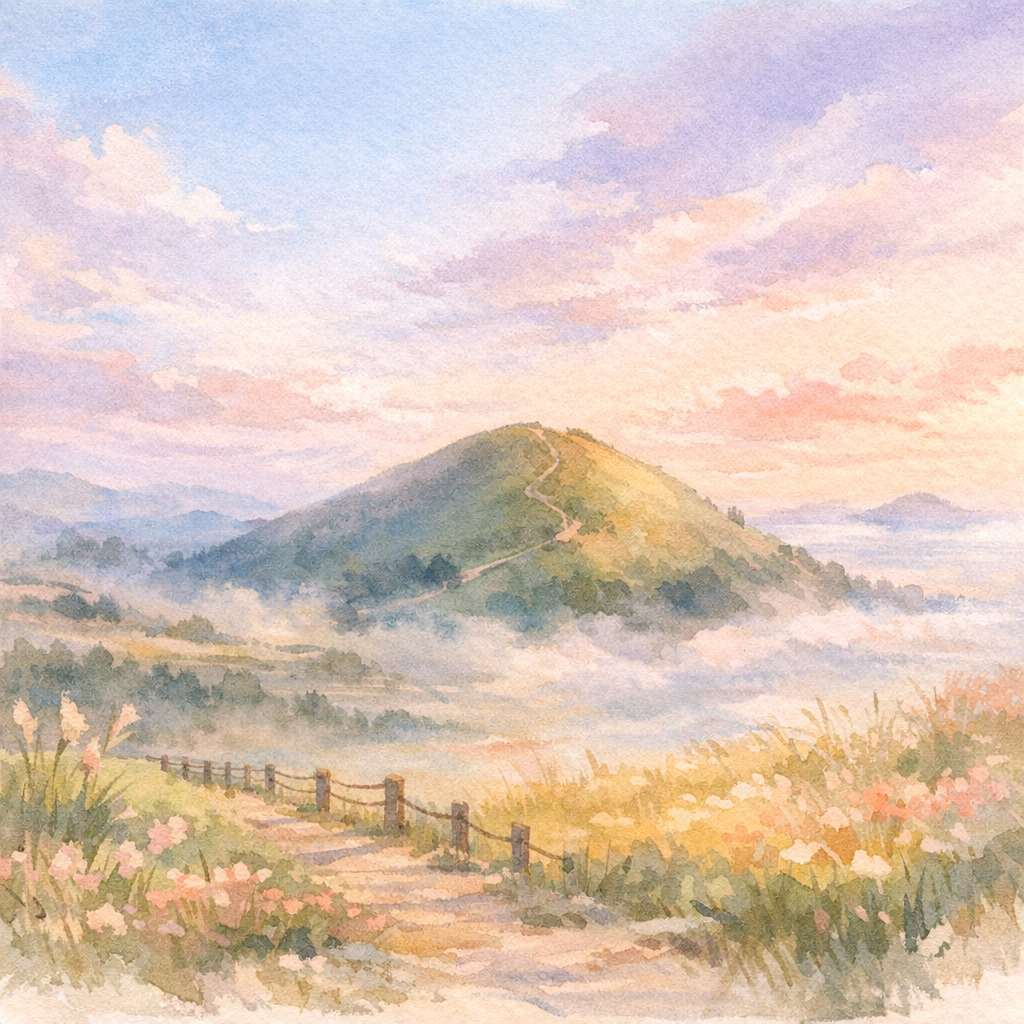
Okay, so if you’re planning a trip to Jeju Island, I’m guessing the usual names are already sitting in your browser tabs. Hallasan. Seongsan Ilchulbong. Woljeongri Beach. Maybe a café in Aewol with a sea view and a dessert that costs almost as much as lunch. I get it. They’re famous for a reason.
But let me talk about a place that feels a little more personal to me. Not completely unknown, no, locals definitely know it, and Korean travelers go there too. But compared to Jeju’s headline attractions, Saebyeol Oreum still has this quiet, open, slightly mysterious feeling. Like the island is letting you into a side room instead of the main hall.
Saebyeol Oreum is a volcanic cone in the Aewol area of western Jeju. “Oreum” means a small parasitic volcanic cone, and Jeju has loads of them. Saebyeol is especially loved for its wide grassy slopes, soft ridgeline, and that huge sky above it. The name “Saebyeol” is often translated as “new star,” which sounds a bit poetic, maybe even too pretty, but honestly... when you stand there before sunrise or near sunset, it kind of fits.
I’m a 40-something IT office worker, so my normal life is basically screens, meetings, messages, and pretending not to panic when a system alert pops up at 5:55 p.m. When I travel, I don’t always want another crowded “must-see” checklist spot. Sometimes I just want wind, space, and a place where my brain can reboot quietly. Saebyeol Oreum does that. Not in a dramatic way. More like, “Hey, breathe properly for once.”
Why Saebyeol Oreum Feels Different from the Usual Jeju Tourist Spots
The funny thing about Saebyeol Oreum Jeju is that it doesn’t try too hard. There’s no grand gate, no huge temple, no flashy sign screaming at you to take a photo here. You park, you look up, and there it is: a smooth volcanic hill rising out of the landscape like a green wave frozen in place.
The hike is short, but don’t let that fool you. Short doesn’t always mean easy-peasy. The slope can feel a bit steeper than it looks from below, especially if you went too hard on black pork the night before. Still, for most travelers, it’s very doable. If you walk slowly and take little breaks, you can reach the top in about 20 to 40 minutes depending on your pace, weather, and how many photos you stop to take. And you will stop. The view keeps changing every few steps.
What I like most is the openness. Some Jeju attractions feel beautiful but managed, like you’re being guided along a fixed route with everyone else. Saebyeol Oreum feels more relaxed. The grass moves with the wind. The sky feels close. You can see the surrounding fields, roads, distant sea, and depending on the weather, other oreums sitting quietly in the distance.
There’s a kind of silence here that isn’t totally silent. You still hear cars far away, maybe people talking near the trail, maybe wind brushing past your ears. But compared to the big-name sunrise spots, it feels calmer. Less performance. More breathing room.
And yeah, I know “hidden gem” is an overused travel phrase. I try not to throw it around too easily. But Saebyeol Oreum has that feeling where you think, “Why didn’t I come here earlier?” Not because nobody knows it, but because it gives back much more than the effort you put in. That’s my kind of travel math.
The Sunrise Mood: Not Always Perfect, But Weirdly Better That Way
Let’s be honest. The title says sunrise, and sunrise at Saebyeol Oreum can be gorgeous. The sky slowly turns from dark blue to pale gray, then pinkish orange, and the grass starts glowing in that soft morning light. If the weather is clear, it’s a proper “stand still and shut up for a second” kind of view.
But here’s the part travel blogs don’t always say: Jeju weather has a personality. A strong one. You can wake up early, drive in the dark, climb with all your noble traveler energy, and still get clouds. Or fog. Or wind that makes your hair look like you lost an argument with a hair dryer.
And strangely, I don’t think that ruins it. Saebyeol Oreum with clouds can feel even more cinematic. The hill becomes softer, the landscape looks like a scene from a quiet Korean indie film, and everyone talks in lower voices for some reason. Maybe because morning does that to people.
When I visited early in the morning, I brought coffee in a small tumbler because, well, I’m Korean and an office worker. Caffeine is basically emotional support. I remember sitting on the slope for a few minutes, holding that warm cup, and thinking about nothing useful at all. That was the best part. No productivity. No calendar. Just wind and coffee. Honestly, I recommend that more than any expensive wellness program.
One very real tip from my own mistake: bring a windbreaker, even if the weather app looks friendly. The bottom of the hill can feel fine, but the top gets windy fast, especially around sunrise. I once went up thinking, “It’s Jeju, how cold can it be?” Bad question. Very bad question...
K-Drama and K-Pop Vibes Without Forcing the Connection
Now, if you’re visiting Korea because you love K-drama filming locations, K-pop travel spots, or just that soft Korean cinematic mood, Saebyeol Oreum makes a lot of sense. I don’t want to oversell it as some official mega-famous filming location for a specific drama, because as far as I know, it’s not one of those places where every tour bus stops because one actor cried there in episode 12.
But the feeling? Oh, it’s absolutely there.
Think of those quiet scenes in Korean dramas where the character walks alone after a life crisis, the wind is doing half the acting, and the camera pulls back to show a wide open landscape. That’s the kind of energy Saebyeol Oreum has. It’s not loud. It’s not glamorous. It’s the “I need to figure myself out” location. Very healing drama. Very playlist-at-6-a.m. mood.
If you’re a fan of artists like BTS, IU, NewJeans, SEVENTEEN, or BLACKPINK, you’ll probably understand this kind of place. K-pop isn’t only about stages, lights, and music videos in Seoul. A lot of the emotional pull of Korean pop culture comes from contrast: huge city energy, then suddenly nature; intense schedules, then a quiet sea; polished performance, then a simple landscape where someone can just exist for a while.
Jeju is exactly that kind of escape. Many Korean celebrities and idols visit Jeju privately because it gives them space, and places like Saebyeol Oreum have that low-key atmosphere. Not a “go stalk idols” place, please don’t do that. More like, if you want to understand why Korean artists often sing about seasons, wind, memory, and lonely roads, standing on an oreum in Jeju helps. It sounds dramatic, I know. But it’s true.
Photo Ideas for K-Drama-Style Shots
If you want photos that feel like a drama poster without looking too staged, Saebyeol Oreum is great because the background is clean. Grass, sky, curve of the hill. That’s it. No messy neon signs, no random convenience store banner behind your head.
- Sunrise silhouette shot: Stand slightly below the ridge while your friend shoots upward. You’ll get a clean outline against the morning sky.
- Walking-away shot: Very K-drama, honestly. Walk along the slope, don’t look back, pretend you just made a difficult life decision.
- Wide landscape shot: Use 0.5x on your phone if you have it. The curve of the oreum looks beautiful with a wider frame.
- Windy hair shot: Don’t fight the wind too much. Sometimes messy looks more real. Actually, most times.
Small practical thing: don’t step into restricted or protected areas just for photos. Jeju’s oreums are natural landscapes, and the grassland needs care. A good photo is nice, but not nice enough to damage the place. Maybe that’s my middle-aged uncle philosophy coming out, but I stand by it.
How Hard Is the Saebyeol Oreum Hike?
For most foreign travelers, Saebyeol Oreum hiking is manageable. It’s not a full mountain hike like Hallasan, and you don’t need professional gear. But it is still a hill, and the incline can surprise you. If you’ve been walking around Jeju all day, your legs may complain a bit.
The trail is mostly open, so shade can be limited. In summer, that means early morning or late afternoon is much better. In winter, the wind can feel sharp. Spring and autumn are probably the most comfortable seasons, though Jeju never fully follows the rules. It does what it wants.
What to Wear and Bring
- Comfortable walking shoes: Sneakers are fine, but avoid slippery soles. The path can be dusty or muddy depending on the weather.
- Windbreaker or light jacket: Seriously, bring it. The top is windier than the parking area.
- Water: It’s a short hike, but you’ll still want it, especially in warmer months.
- Phone with enough battery: For maps, photos, translation apps, and emergency use.
- Small flashlight or headlamp: If you go before sunrise, your phone light works, but a small flashlight is more comfortable.
My realistic advice? Don’t carry a huge backpack unless you really need to. I’ve made that mistake on short hikes because I like to be “prepared,” which in my case sometimes means carrying three things I never use. Saebyeol Oreum is better enjoyed light. Water, jacket, phone, maybe a snack. Done.
Getting to Saebyeol Oreum: Car Is Easiest, But Plan Ahead
Saebyeol Oreum is in the Aewol side of Jeju, so it’s not far from many western Jeju routes. If you’re renting a car, it’s pretty straightforward. And honestly, for Jeju, renting a car makes life much easier. Public transportation exists, of course, but buses can take time, and some routes are not ideal if you’re chasing sunrise.
Use Naver Map or KakaoMap instead of relying only on Google Maps. This is one of those Korea travel tips that sounds boring but saves you real frustration. Google Maps can be limited in Korea, especially for navigation details. Naver Map is more local, more accurate, and usually better for driving routes, parking, and nearby restaurants.
Best Time to Visit
- Sunrise: Best for quiet mood, soft light, and fewer people. Arrive 30 to 40 minutes before sunrise if you want time to climb slowly.
- Late afternoon: Great for golden light and a warmer color tone in photos. Sunset can be beautiful too.
- Middle of the day: Still nice, but it can feel bright, hot, and less atmospheric, especially in summer.
- Weekdays: Usually more peaceful than weekends or holiday periods.
Parking is generally available near the entrance, but during popular seasons or events, it can get busier than expected. Jeju has this funny way of feeling empty one minute and suddenly crowded the next. If you’re visiting during peak travel dates, give yourself extra time.
What to Eat Near Saebyeol Oreum: Jeju Food That Actually Feels Worth It
After the hike, hunger hits differently. Maybe it’s the fresh air. Maybe it’s the early wake-up. Maybe your body is just saying, “Nice view, now feed me.” Around Saebyeol Oreum and the broader Aewol/Hallim area, you’ll find plenty of food options, from local Korean meals to pretty cafés that foreign travelers usually love.
I’ll say this gently but clearly: don’t only chase the most viral restaurant on Instagram. Some are good, sure. Some are just good at lighting. In Jeju, the places that look a little plain from outside can be the ones that make you happiest.
Jeju Black Pork BBQ
Jeju black pork is one of the island’s signature foods, and it’s a very satisfying meal after hiking. The meat is usually thicker than regular pork belly, with a deeper flavor and nice chew. Grill it over charcoal if possible, wrap it in lettuce or perilla leaf, add ssamjang, garlic, maybe some kimchi, and yeah... that’s a proper Jeju meal.
If you’re not comfortable grilling, don’t panic. Many restaurant staff will help, especially if they see you looking at the meat like it’s a software bug with no documentation. I’ve been there. One owner once came over, flipped everything with perfect timing, and gave me this look that basically said, “Please let the professional handle it.” Fair enough.
Gogi Guksu: Pork Noodle Soup
Gogi guksu is another Jeju comfort food I really like. It’s a warm pork noodle soup, usually with slices of pork, a rich broth, and simple toppings. Nothing fancy, but that’s the point. After a windy morning hike, a bowl of gogi guksu feels like someone fixed your internal battery.
Foreign visitors who enjoy ramen or Japanese-style noodle soups often like this dish too, though the flavor is very Korean and very Jeju. If you don’t eat pork, check before ordering because the broth is usually pork-based.
Seafood Hot Pot and Abalone Dishes
Since you’re in Jeju, seafood is always a strong move. Haemulttukbaegi, a bubbling seafood hot pot, is great when the weather is cool. You’ll often get shrimp, clams, crab, abalone, or whatever the restaurant specializes in. It’s spicy, warm, and messy in the best way.
Abalone porridge, called jeonbokjuk, is gentler and easier if your stomach isn’t ready for spicy food early in the day. It’s also popular with travelers who want something nourishing but not too heavy.
Hallabong Juice, Tangerine Desserts, and Omegi Tteok
For something lighter, grab Hallabong juice or fresh tangerine juice. Jeju citrus is famous, and yes, sometimes it tastes better in Jeju just because you’re drinking it with island air. Is that scientific? Probably not. Do I care? Not really.
Omegi tteok is a traditional Jeju rice cake often made with millet and red bean. It’s chewy, slightly sweet, and perfect with coffee or tea. If you’re buying souvenirs, individually wrapped omegi tteok can be a nice edible gift, though check how long it lasts before flying home.
Cafés Near Saebyeol Oreum and Aewol: Where Foreign Travelers Usually Feel Comfortable
The Aewol area is famous for cafés, and some are genuinely lovely. If your travel style includes coffee, ocean views, and sitting quietly while pretending to write a novel in your head, you’ll have fun here.
Near Saebyeol Oreum, you’ll find countryside-style cafés, and if you drive toward the coast, Aewol’s seaside cafés offer those classic Jeju views. Some places have English menus, some don’t, but ordering coffee is usually simple enough. Translation apps help a lot. Also, Korean café staff are generally used to travelers, especially in Jeju.
- For a calm post-hike break: Look for cafés near the oreum or along the road toward Aewol. Countryside cafés are less crowded in the morning.
- For ocean views: Drive toward Aewol Coastal Road. It’s more touristy, but the sea view can be worth it.
- For dessert lovers: Try citrus cakes, tangerine ade, or green tea desserts if available.
My personal café rule in Jeju is simple: if the view is amazing, the coffee only needs to be decent. If the coffee is amazing too, that’s a bonus. Maybe that sounds too forgiving, but when the sea is right there, I become a kinder person.
A Simple Half-Day Route Around Saebyeol Oreum
If you don’t want to overthink your schedule, here’s a relaxed route that works well, especially if you’re staying in Jeju City, Aewol, or Hallim.
- Early morning: Drive to Saebyeol Oreum before sunrise. Climb slowly and enjoy the view.
- After the hike: Have breakfast nearby. Gogi guksu, seafood soup, or abalone porridge all work well.
- Late morning: Head toward Aewol Coastal Road for coffee and ocean views.
- Midday: Visit nearby beaches like Gwakji Beach or Hyeopjae Beach if you want more nature.
- Lunch: Go for black pork BBQ or a local seafood meal before continuing your Jeju itinerary.
This kind of route is nice because it doesn’t feel rushed. Jeju is not a place I like to attack with a military schedule. The island rewards wandering a bit. Stop when the light is pretty. Pull over safely when the sea suddenly looks too blue. Buy a random citrus snack. That’s part of the trip.
Things Foreign Visitors Should Know Before Going
Saebyeol Oreum is easy to enjoy, but a few small things make the visit smoother. Nothing complicated, just the kind of stuff I wish someone had told me before my earlier Jeju trips.
- Use local map apps: Naver Map or KakaoMap will make your life easier in Korea.
- Check the weather twice: Jeju wind and rain can change plans fast.
- Don’t expect lots of facilities on the trail: Use the restroom before climbing if needed.
- Respect the landscape: Stay on allowed paths and avoid damaging grass or private land.
- Bring cash just in case: Most places take cards, but small local spots sometimes feel smoother with a little cash backup.
- Download a translation app: Papago is especially useful in Korea for menus and signs.
Also, if you’re driving before sunrise, be careful. Some Jeju roads are dark, and navigation can feel a bit lonely in the early morning. I like driving, but I still slow down more than usual in Jeju because rental cars, unfamiliar roads, and sleepy tourists are not the best combination.
Is Saebyeol Oreum Worth Adding to Your Jeju Itinerary?
For me, yes. Very much yes.
Not because it’s the biggest attraction. Not because it has the most dramatic cliff or the most famous photo zone. I like Saebyeol Oreum because it gives you that rare Jeju feeling without demanding too much from you. A short climb, a wide sky, some wind, and suddenly your day feels cleaner.
If you’re traveling to Korea for K-pop culture, K-drama scenery, or just beautiful places that feel emotionally Korean in that quiet, slightly bittersweet way, this spot fits beautifully. It’s not a theme park version of Korea. It’s just a hill. But sometimes a hill with the right light is enough.
Go for sunrise if you can. Bring a jacket. Don’t rush the climb. Afterward, eat something warm and local, then drive toward the coast with your favorite Korean playlist on. Maybe IU. Maybe BTS. Maybe something old and sentimental that makes no sense to anyone else in the car.
That’s the thing about Jeju. The best memories are not always the famous ones. Sometimes they’re just wind on a grassy oreum, coffee in your hand, and a morning that feels like it belongs only to you...
댓글
댓글 쓰기