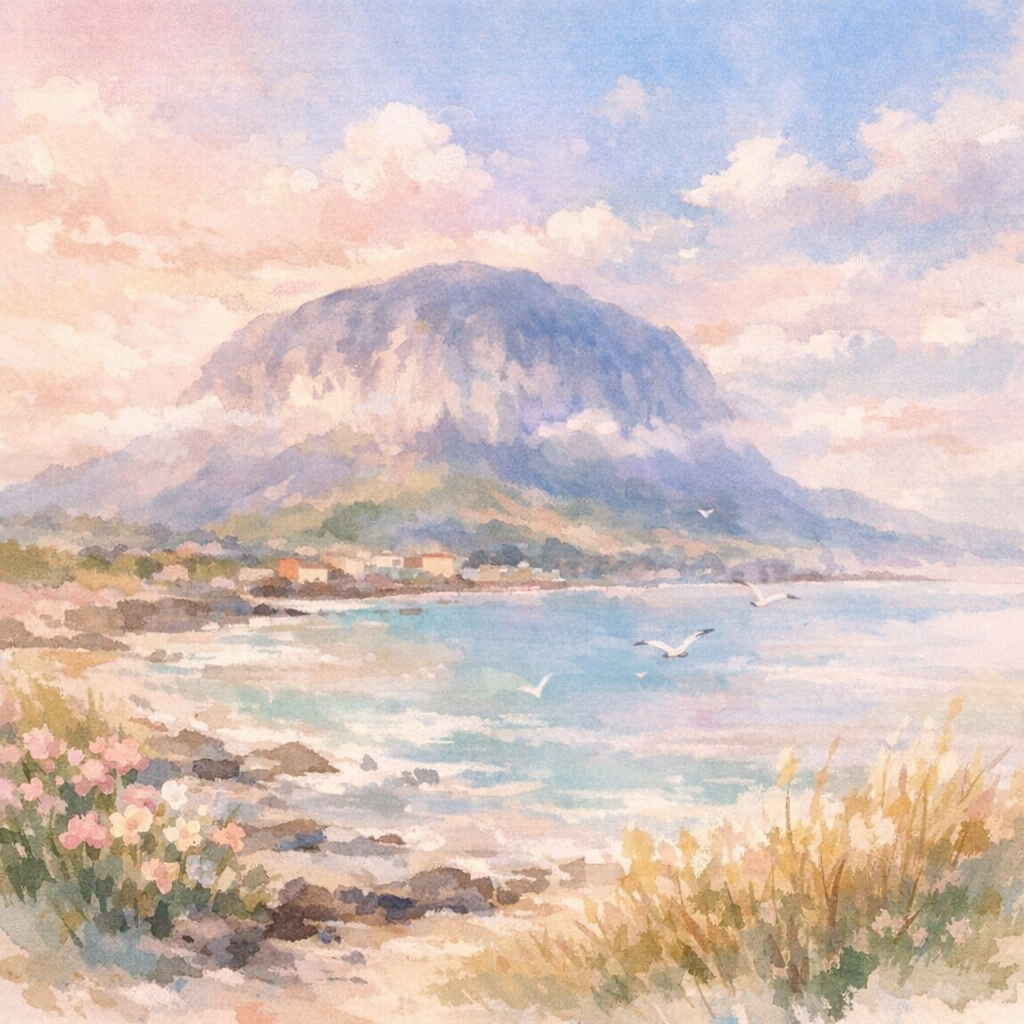
You know how everyone talks about Hallasan or Seongsan Ilchulbong when Jeju comes up? Fair enough, those places are famous for a reason. But honestly, if a friend asked me for one Jeju spot that feels dramatic, easy to visit, a little mysterious, and weirdly cinematic, I’d probably say Sanbangsan Mountain without thinking too long.
It’s not the tallest mountain in Jeju. Not even close. But that’s kind of the point. Sanbangsan doesn’t try to impress you by being huge. It just sits there near the coast like some giant volcanic dome dropped into the landscape by a game designer who got carried away with the “epic background” setting. As a 40-something IT office worker who spends too many weekdays staring at dashboards and error logs, I really appreciate places like this. No complicated itinerary. No extreme hiking. Just a strong visual punch, some sea air, a temple tucked into a cliff, and good food nearby. That’s a pretty nice combo, no?
And if you’re visiting Korea because of K-dramas, Korean movies, KPOP, or variety shows, this whole Sanbangsan and Yongmeori Coast area has that “I’ve seen this kind of scene before” feeling. Even when it’s not the exact filming spot from your favorite drama, the mood is very Jeju-on-screen: volcanic rock, ocean wind, slow camera pans, someone looking emotionally troubled near the sea... you know the vibe.
Why Sanbangsan Feels So Different from Other Jeju Attractions
Sanbangsan Mountain is about 395 meters high, so no, you’re not climbing Everest here. But the shape is what gets you. It’s this rounded volcanic peak rising almost suddenly from the coastal plain, and because the land around it is relatively open, the mountain looks much bigger than the number suggests. It has presence. That’s the word.
Technically, Sanbangsan is a volcanic formation created a very long time ago, and the name means something like “mountain with a cave.” That cave part matters because the famous Sanbanggulsa Grotto is built into the side of the mountain. But before you even start walking up, you’ll probably stop in the parking area and just stare for a second. I did. I mean, maybe I’m easily impressed after too much office life, but still.
The best thing is that Sanbangsan doesn’t feel polished in a boring way. Some Korean tourist spots are almost too organized, right? Signs everywhere, photo zones everywhere, same café design everywhere. Sanbangsan has tourist facilities too, of course, but the mountain itself still feels raw. Volcanic. Heavy. A little moody. On a cloudy day, it almost looks like a fantasy drama location where some immortal character might show up wearing a long coat.
The “K-drama Mood” Around Sanbangsan and Yongmeori Coast
If you’re the kind of traveler who likes Korean drama filming locations in Jeju, you should think of Sanbangsan together with nearby Yongmeori Coast. They’re basically neighbors, and the whole area has been loved by drama crews, commercial shoots, travel shows, and music-video-style content because the background is just ridiculously good.
Now, I’ll be honest here. I don’t like pretending every single rock was used by some idol group or drama actor. The internet does that too much. But the Sanbangsan and Yongmeori Coast area really does carry the kind of scenery Korean productions love: black volcanic cliffs, crashing waves, quiet temple paths, and that slightly lonely Jeju coastline. It’s very easy to imagine a breakup scene, a reunion scene, or a music video where someone walks slowly while the wind does half the acting.
If you’re chasing exact K-drama filming spots, I’d suggest checking Naver blogs or the official tourism pages before you go, because filming-location information changes and sometimes fans find more accurate frame-by-frame spots than travel guides do. But even if you’re not doing that level of detective work, this area is still a very satisfying stop for anyone who enjoys Korean screen culture.
The Grotto Temple: Small Climb, Big Reward
At the base of Sanbangsan, you’ll find Sanbanggulsa Grotto Temple, one of the most memorable little temple visits in Jeju. It’s not one of those giant temple complexes where you spend half a day trying to understand the layout. This one is more direct. You climb stone steps along the side of the mountain, reach the grotto, and suddenly the view opens up toward the sea.
The walk usually takes around 15 to 20 minutes, depending on your pace and how often you stop to take photos. And you will stop. The stairs, the rock wall, the ocean behind you... it’s all very photogenic without trying too hard. Inside the grotto, the atmosphere becomes quieter. There’s a Buddha statue, candlelight, water dripping from the rock, and that strange cool air you get inside caves. 뭐랄까, it makes you slow down a bit, even if you came only for the view.
I visited once after light rain, and here’s my very real, slightly embarrassing tip: don’t wear slippery fashion sneakers. I nearly lost my dignity on those stone steps. Not my life, thankfully, just my dignity. Since then, I wear shoes with proper grip when I visit temple or coastal rock areas in Jeju, because Jeju wind plus wet stone is not a cute combination.
What Makes the View Worth the Steps
When you look out from near the grotto, you can see the ocean, the low coastal area, and sometimes even farther toward the islands depending on the weather. On a clear day, the blue is sharp and clean. On a misty day, it gets more mysterious. I know people always say “the view is amazing,” and yes, that phrase is overused, but here it actually fits.
The view also gives you a better sense of Jeju’s landscape. It’s not just beaches and cafés. It’s volcanic land, farmland, temples, cliffs, wind, sea, and little villages all mixed together. That’s what I like about Sanbangsan. It doesn’t separate “nature” and “culture” neatly. They just sit next to each other, like they’ve always been there.
KPOP Fans, Variety Show Lovers, and the Jeju Photo Hunt
If your Korea trip has a KPOP travel angle, Sanbangsan is not the same kind of destination as HYBE Insight, K-Star Road, or music show studios in Seoul. You won’t find idol handprints everywhere or official fan merchandise stalls. But Jeju has become a popular background for idol content, seasonal photo shoots, travel variety episodes, and YouTube-style videos, and Sanbangsan’s area has exactly the kind of scenery that looks expensive on camera.
Foreign fans often come to Jeju looking for places that feel like album jacket photos or summer comeback teasers. In that sense, the Sanbangsan area delivers. The mountain gives you a strong background, Yongmeori Coast gives you dramatic sea cliffs, and nearby cafés give you that clean, bright Jeju aesthetic that shows up all over Korean celebrity travel content.
One small tip from a guy who takes too many photos: if you want that “idol travel vlog” look, don’t shoot only the mountain straight on. Move a little. Use the road, the low stone walls, the fields, the temple stairs, or the coastline as foreground. Your photos will feel much less like a postcard and more like you were actually inside the scene. Sounds obvious, but honestly, most people just stand in the parking lot and take the same picture.
Best Photo Spots Around Sanbangsan
- Sanbangsan parking area viewpoint: Easy, quick, and good for that classic mountain-dome shot. Not the most original, but it works.
- Steps toward Sanbanggulsa Grotto: Great for layered photos with stone steps, temple details, and sea views behind you.
- Yongmeori Coast entrance area: If the coast is open, this is one of the most dramatic places nearby. Always check tide and weather conditions.
- Roadside views near Sanbangsan: Some of the best shots are not from an official photo zone. Just be careful with traffic, seriously.
- Cafés facing the mountain: Good for relaxed travel photos, especially if you’re tired but still want something Instagram-friendly.
Yongmeori Coast: Don’t Skip It If the Weather Allows
Since you’re already at Sanbangsan, you should absolutely try to visit Yongmeori Coast as well. The name means “Dragon Head Coast,” and once you see the layered sandstone cliffs stretching along the sea, the name makes sense. It looks like something carved by a giant creature, or by time itself if we’re being less dramatic. But I prefer the dragon version. More fun.
Here’s the annoying but important part: Yongmeori Coast is not always open. Because it’s right by the sea, access depends on tides, wind, and wave conditions. I’ve had one visit where it was open and gorgeous, and another where it was closed because the waves were too strong. That second time, I grumbled for about five minutes and then went for seafood instead. Not a bad recovery plan.
If it’s open, wear comfortable shoes and don’t rush. The rock layers are beautiful, but the walking surface can be uneven. Also, the wind can be intense. If you have long hair, bring a hair tie. If you wear a hat, hold onto it. Jeju wind has no manners.
Where to Eat Near Sanbangsan: Food That Actually Makes Sense After Walking
Let’s talk about food, because no good Jeju day should end with a sad convenience-store sandwich unless you’re on a desperate schedule. Around Sanbangsan, you’ll find seafood, abalone dishes, black pork, casual noodle places, and cafés with mountain or ocean views. The area is tourist-friendly, but it still has local flavor if you choose well.
Foreign visitors usually do well with dishes that are flavorful but not too intimidating on the first bite. Jeju seafood is fresh, and abalone is a big deal here. If you’re tired after walking, jeonbok juk, or abalone porridge, is one of the safest and most comforting choices. It’s warm, mild, slightly nutty, and easy on the stomach. Very underrated after a windy coastal walk.
Good Food Choices Near Sanbangsan
- Abalone porridge: A gentle, comforting Jeju classic. Great for breakfast or lunch, especially if you don’t want spicy food.
- Seafood ramen: More casual and fun. Many places around Jeju serve ramen topped with crab, shellfish, shrimp, or abalone.
- Haemul pajeon: Seafood scallion pancake. Crispy edges, soft middle, and very good with makgeolli if you’re not driving.
- Jeju black pork: A solid dinner option if you’re staying nearby or heading back toward Seogwipo.
- Grilled mackerel or cutlassfish: Very Korean, very Jeju, and usually friendly for travelers who like seafood but don’t want raw dishes.
If you want a place with a more modern Jeju vibe, look for cafés around the Sanbangsan view roads. Some of them have outdoor seating facing the mountain, and yes, the coffee can be a little overpriced. But sometimes you’re paying for the chair, the view, and the feeling of not answering work emails. As an IT guy, I respect that business model more than I probably should.
A Very Real Food Tip
Try to avoid peak lunch time if you can. Around 12 to 1:30 PM, popular restaurants near tourist spots can get crowded fast, especially on weekends and holidays. I usually either eat early around 11:15 or go late after 2 PM. It’s not glamorous advice, but it saves time, and time is the real luxury when you’re traveling.
How to Get to Sanbangsan Without Losing Your Mind
The easiest way to visit Sanbangsan Mountain is by rental car, especially if you’re planning to combine it with Yongmeori Coast, Osulloc Tea Museum, or other west-side Jeju attractions. Parking is available near the entrance, though it can fill up during busy seasons. If you’re driving in Jeju for the first time, just take it slow. Some roads feel peaceful, then suddenly a tour bus appears like a boss monster.
If you don’t want to drive, you can still get there by bus. From Jeju City or Seogwipo, use Naver Map or KakaoMap and search for Sanbangsan or Sanbangsan Mountain. Bus routes can change, and travel times depend a lot on where you start, but the Sanbangsan area is well-known enough that public transport is possible. Just don’t expect Seoul subway-level convenience. Jeju moves at its own pace.
Another good option is a half-day or full-day west Jeju tour. This can be especially nice if you’re visiting Korea for the first time and don’t want to think too hard about bus transfers. Some tours include Sanbangsan, Yongmeori Coast, Osulloc Tea Museum, Songaksan Mountain, or nearby coastal cafés. For K-drama and KPOP fans, a guide can sometimes point out spots used in shows, commercials, or celebrity travel content, though again, I’d treat unofficial claims with a tiny bit of caution.
Simple Route Ideas
- Relaxed half-day: Sanbangsan Grotto Temple, Yongmeori Coast, café with a mountain view.
- Food-focused route: Sanbangsan walk, abalone porridge or seafood ramen, coastal café, sunset near the sea.
- Photo route: Sanbangsan viewpoint, temple steps, Yongmeori Coast if open, roadside mountain shots during golden hour.
- West Jeju day trip: Osulloc Tea Museum, Sanbangsan, Yongmeori Coast, Songaksan, black pork dinner.
Best Time to Visit Sanbangsan
Morning is usually the most comfortable time. The air feels cleaner, parking is easier, and the light is softer. If you visit in summer, this matters a lot because Jeju sun can be surprisingly aggressive. I once thought, “It’s just a short walk, I’ll be fine,” and then spent the next hour sweating like a laptop fan during a bad software update. Not my proudest travel moment.
Late afternoon is beautiful too, especially for photos. The volcanic rock gets warmer in color, and the whole area feels calmer after the day-trip crowds start moving away. Just remember that temple entry hours and coastal access times can vary, so don’t arrive too late if the grotto is your main goal.
Season-by-Season Feel
- Spring: Fresh air, flowers, and nice walking weather. Probably my favorite season for Sanbangsan.
- Summer: Strong sun, dramatic blue skies, and sweaty stairs. Bring water. No, really, bring water.
- Autumn: Clearer air, comfortable temperatures, and beautiful light for photography.
- Winter: Quieter and moodier. Wind can be brutal, but the atmosphere is special if you dress properly.
Small Practical Things That Make the Visit Better
Sanbangsan is not a difficult destination, but a few small choices can make your day much smoother. I’m not a hardcore planner, but I do believe in removing unnecessary pain from travel. Life already has enough random bugs.
- Wear shoes with grip: Stone steps and coastal rocks can get slippery, especially after rain.
- Carry water: You can buy drinks nearby, but having your own is easier and cheaper.
- Check Yongmeori Coast conditions: It may close because of tides or rough waves.
- Bring a light jacket: Even when the weather looks mild, Jeju wind can surprise you.
- Use Naver Map or KakaoMap: Google Maps is not always the best for detailed Korea navigation.
- Go early on weekends: Parking and restaurants get busy faster than you expect.
Why I’d Recommend Sanbangsan to a Friend Visiting Jeju
Sanbangsan isn’t trying to be the biggest, trendiest, or most famous place in Jeju. And that’s exactly why I like it. It gives you a lot without demanding too much. A short climb. A sea view. A cave temple. A strong volcanic landscape. Food nearby. A little pop-culture imagination if you’re into Korean dramas and KPOP-style travel spots. That’s a pretty generous package.
If you’re coming to Jeju for the first time, sure, go see the famous places. But leave room for Sanbangsan. It has that slightly secret-level feeling, like you wandered off the main route and found something better than expected. And honestly, those are the places I remember most.
So yeah, put Sanbangsan Mountain in Jeju on your list. Bring decent shoes, check the weather, eat something warm afterward, and don’t rush the view. If you see some middle-aged guy taking way too many photos of the same rock because the light changed by 2%, well... that might be me.
댓글
댓글 쓰기